Household Workers Unite: The Untold Story of African American Women Who Built a Movement by Premilla Nadasen
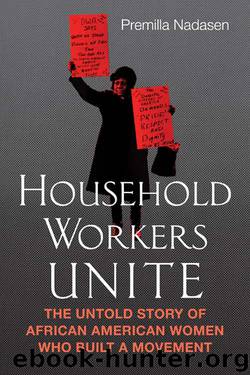
Author:Premilla Nadasen [Nadasen, Premilla]
Language: eng
Format: epub, azw3
Tags: #bio, #pw3
ISBN: 9780807033197
Amazon: 0807033197
Goodreads: 28186069
Publisher: Beacon Press
Published: 2015-08-25T00:00:00+00:00
RACE, GENDER, AND WORK
The male-dominated congressional debate surrounding the minimum wage bill exposed the racial and gender assumptions about women, housework, race, and class embedded in social policy. Politicians and policymakers framed housework and domestic work as primarily women’s work and cast minimum wage for domestic workers in terms of the rights of domestic workers versus the rights of housewives.24 Legislators opposed the minimum wage bill because they claimed it would bring “the federal bureaucracy into the kitchen of the American housewife,”25 and they wanted to protect the domain of white middle-class women.26 Robert Thompson of the US Chamber of Commerce predicted a flood of “irate housewives,” because the law would increase costs and prohibit some women from hiring domestic workers.27
By relegating the question of minimum wage for domestic workers to the “women’s sphere,” male politicians employed a rhetorical strategy that absolved them of any responsibility for the legal rights of domestic workers. They used the cloak of gender to dismiss the class and race politics that were central to the exclusion of domestic workers from labor legislation. They placed responsibility for low wages and poor treatment squarely on the shoulders of middle-class female employers—their “wives”—and framed domestic work as an occupation that took place in the privacy of the home, which legislators presumably could not regulate. This argument about the sanctity of the private sphere reinforced the artificial construction of the home as a personal space of refuge devoid of politics. Compounding the home/business distinction, policymakers also claimed that housewife-employers were incapable of complying with the law and keeping records, thus making the legislation impractical because housewives had minimal business knowledge. Secretary of Labor Peter Brennan explained: “Homemakers are not engaged in business in the traditional sense with experience in maintaining business records.”28 Brennan supported the minimum wage increase but opposed extending coverage to household workers, a position that reflected his class politics. Born and raised in New York City, Brennan was of working-class origin and a certified union man. He started off as a housepainter during the Depression—working, ironically, like household employees and housewives, in the domestic sphere. He rose up the ranks of the Painters Union and eventually became president of the Building and Construction Trades Council of Greater New York. He served as secretary of labor under Presidents Nixon and Ford from 1973 to 1975. Although Brennan was an unwavering advocate for the rights of working people, his opposition to the minimum wage for domestic workers illustrates his somewhat narrow gender- and race-based view of labor.
Although Brennan seemed to discount the importance of household labor, a closer reading of the FLSA legislative debate underscores a deeper concern of congressmen and administration officials. They were fearful not only of “irate” housewives and their supposedly inadequate accounting practices but also of a potential disruption of the gender division of labor and its consequences. Clearly defining and recognizing domestic work posed a particular problem for male politicians, who quickly realized that raising the status of domestic workers meant raising the status of unpaid household work performed by many women.
Download
Household Workers Unite: The Untold Story of African American Women Who Built a Movement by Premilla Nadasen.azw3
This site does not store any files on its server. We only index and link to content provided by other sites. Please contact the content providers to delete copyright contents if any and email us, we'll remove relevant links or contents immediately.
| African-American Studies | Asian American Studies |
| Disabled | Ethnic Studies |
| Hispanic American Studies | LGBT |
| Minority Studies | Native American Studies |
Cecilia; Or, Memoirs of an Heiress — Volume 1 by Fanny Burney(32533)
Cecilia; Or, Memoirs of an Heiress — Volume 2 by Fanny Burney(31931)
Cecilia; Or, Memoirs of an Heiress — Volume 3 by Fanny Burney(31922)
The Great Music City by Andrea Baker(31906)
We're Going to Need More Wine by Gabrielle Union(19027)
All the Missing Girls by Megan Miranda(15902)
Pimp by Iceberg Slim(14471)
Bombshells: Glamour Girls of a Lifetime by Sullivan Steve(14042)
For the Love of Europe by Rick Steves(13836)
Talking to Strangers by Malcolm Gladwell(13335)
Norse Mythology by Gaiman Neil(13324)
Fifty Shades Freed by E L James(13222)
Mindhunter: Inside the FBI's Elite Serial Crime Unit by John E. Douglas & Mark Olshaker(9305)
Crazy Rich Asians by Kevin Kwan(9266)
The Lost Art of Listening by Michael P. Nichols(7483)
Enlightenment Now: The Case for Reason, Science, Humanism, and Progress by Steven Pinker(7300)
The Four Agreements by Don Miguel Ruiz(6733)
Bad Blood by John Carreyrou(6605)
Weapons of Math Destruction by Cathy O'Neil(6252)
